The fear of falling, and how to work with it
Fear of falling holds back almost every climber at some point. Here is how to understand it, practise around it, and climb more freely.

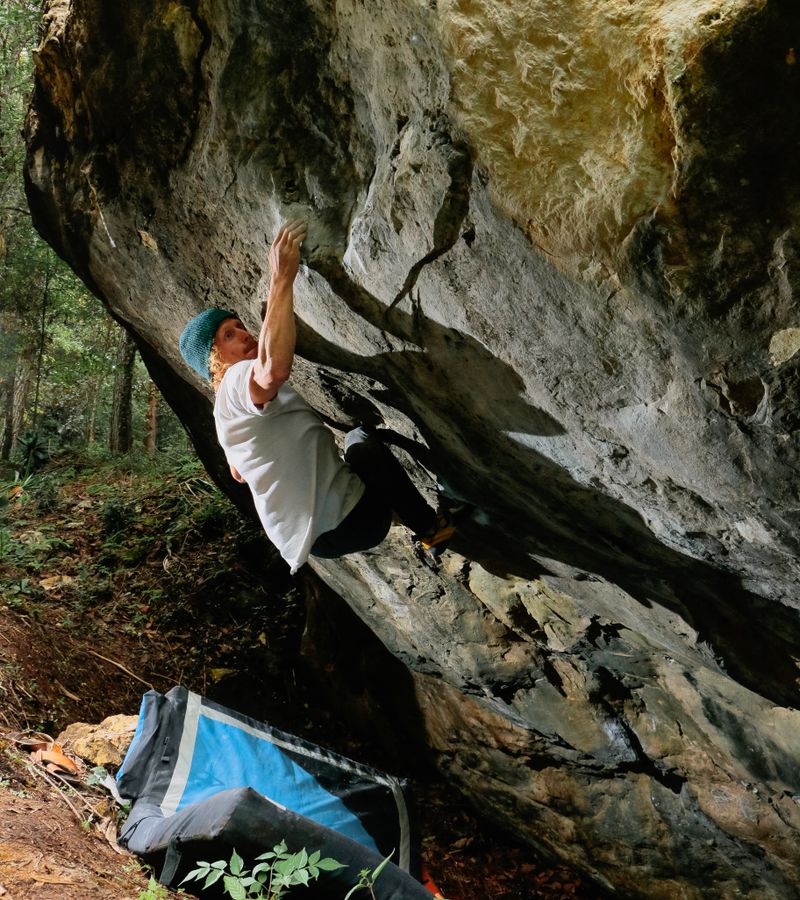
You are two moves from the top, the holds are good, and you know you can do the next move. But your body has quietly decided otherwise. Your breathing has gone shallow, your grip has tightened to a death-clench, and you are stuck, over-gripping a perfectly good hold while a small voice insists that letting go to make the move would be a catastrophe. Almost every climber knows this feeling. The fear of falling is one of the most universal experiences in the sport, and learning to work with it does more for most people's climbing than any amount of finger strength.
The aim here is not to become fearless. Fearlessness is neither realistic nor sensible. The aim is to understand the fear, separate the useful part from the unhelpful part, and slowly expand what you are comfortable with.
Fear is doing a job, just not always a useful one
Your fear of falling is not a flaw. It is a system that kept your ancestors off cliffs, and it is doing exactly what it evolved to do. The trouble is that it cannot tell the difference between a genuinely dangerous fall and a safe one onto a thick mat or a well-belayed rope. It fires the same alarm either way.
So the first mental shift is to stop treating the fear as the enemy and start treating it as information that needs checking. When the alarm goes off, ask a quick honest question: is this actually dangerous, or does it just feel dangerous? On a bouldering wall with good mats and a sensible landing, a fall from low down is genuinely fine. On a high-ball or a bad landing, the fear is right and you should listen. Learning to tell those apart is the whole skill.
You are not trying to delete the fear. You are trying to get an accurate read on the actual risk, so that your body stops sounding the alarm when there is nothing to be alarmed about.
Practise falling, on purpose
You cannot think your way out of a fear of falling. You have to teach your body, through repetition, that falling is survivable. This means practising falling deliberately, in safe and controlled conditions, until it stops feeling like an emergency.
For bouldering, that means learning to fall well and doing it often:
- Start by jumping off from low down onto the mats, landing soft with bent knees
- Roll backwards with the fall rather than fighting to stay upright
- Keep your arms in, do not stick a hand out to brace
- Gradually let go from a little higher as it starts to feel normal
- Do this as part of warming up, so falling becomes routine rather than dramatic
The detail of good technique is worth getting right, and how to fall safely when bouldering and how to downclimb, and why you should both go further. Down-climbing in particular is underrated. Knowing you can reverse out of a position quietly removes a lot of the panic, because you always have a way back.
For roped climbing, the equivalent is practising taking falls with a trusted belayer, starting small with the bolt at your waist and building up. That is a bigger topic, and it depends heavily on trusting the person holding your rope, which is its own thing covered in climbing with a fear of falling.
The breathing trick that actually works
When fear hits, your breathing is the first thing to go, and it is also the thing you have most direct control over. Gripped climbers hold their breath or pant shallowly, which makes everything worse.
The fix is simple and you can practise it anywhere. When you feel the panic rising mid-climb, deliberately breathe out slowly and fully, longer on the out-breath than the in. A long exhale tells your nervous system to stand down. It will not make the fear vanish, but it buys you a few seconds of clearer thinking, which is often all you need to commit to the move you already know you can do. There is more on this in breathing on the wall.
Build a ladder, not a leap
The big mistake is trying to conquer the fear in one heroic go, throwing yourself at the thing that scares you most. That usually ends in a bad scare that sets you back. Instead, build a ladder of small, manageable steps, each only slightly harder than the last.
A rough version might look like this:
- Jump off the mats from knee height until it is boring
- Then from waist height, then chest, then a normal topping-out height
- Climb easy problems and deliberately let go near the top rather than topping out
- Try a move you can do but normally bottle, with mats checked and a spotter ready
- Only then take on the thing that genuinely scares you
Each rung should feel like a stretch but not a terror. If a step floods you with panic, drop back down a rung and spend more time there. Progress here is slow and unglamorous, and that is exactly why it works. You are quietly rewiring how your body responds, one small safe experience at a time.
Be kind to yourself about it
There is a tendency, especially when you watch confident climbers float past their fear, to feel embarrassed about being gripped. Do not be. Fear of falling has very little to do with how good a climber you are. Plenty of strong, experienced climbers are scared witless above a bolt, and plenty of beginners are oddly calm. It is wired differently in everyone, and it fluctuates with sleep, stress, how the session is going and a dozen other things.
Some days the fear will be loud and you will climb scared, and that is a perfectly valid session. Other days it will be quiet and you will surprise yourself. The trend over months matters far more than any single day. If you are practising falling, breathing deliberately, and nudging your comfort zone outwards bit by bit, you are doing the work, even on the days it does not feel like it.
The fear of falling is not something you beat once and are done with. It is something you build a working relationship with, over years. Get an honest read on the real risk, practise falling until your body believes it is safe, breathe out when the alarm sounds, and climb a little braver each session. You will not become fearless, and you would not want to. You will just stop letting a false alarm keep you off moves you are perfectly capable of making.
Header photo by Beta Boulders
More from the blog
 Mindset & community
Breaking through a climbing plateau
Why progress stalls, and the changes — volume, technique, rest — that get it moving again.
 Mindset & community
Learning from climbing on YouTube
How to use climbing films and channels to learn movement — and watch with a critical eye.
 Mindset & community
What we can learn from how the pros train
The habits elite climbers share — rest, reading, deliberate practice — that any climber can borrow.