Climbing with a fear of falling
Where falling fear comes from and a gradual, practical way to make peace with the air below you.

The fear is doing its job
Almost every climber who leads has, at some point, frozen above a bolt, unable to commit to a move they can physically do. It feels like a personal failing. It is not. Your brain is registering height and exposure and doing exactly what it evolved to do, which is keep you off the edge. Fear of falling is the default setting, and the goal is not to delete it but to retrain it so it stops firing when you are actually safe.
It helps to separate two things. There is rational caution, which keeps you off loose rock and reminds you to check your knot, and you want to keep that. Then there is the disproportionate dread of a clean, safe fall onto good gear, which steals the climbing from you. That second one is the one you can work on, and it responds well to gradual, deliberate practice.
Sort out the real risks first
You cannot talk yourself calm if part of your brain is correctly worried that the fall is not actually safe. So before any fear practice, remove the genuine hazards.
- Climb with a belayer you trust, who you have watched catch well.
- Learn what a soft catch is and ask for one, so falls are gentle rather than a hard slam into the wall.
- Understand the situations where a fall really is dangerous: low down near the ground, below your first few bolts, near ledges, or where you might swing into something. Avoiding falls there is sound judgement, not fear.
Once you know the difference between a safe fall and a dangerous one, your nervous system has something honest to work with. Trying to override well-founded fear is exhausting and counterproductive.
Practise falling on purpose
The core of the work is fall practice, done in small steps and on safe terrain such as a steep gym wall or an overhanging sport route where you cannot hit anything. The idea is to give your body repeated proof that the fall is fine, until the proof outweighs the dread.
A gradual ladder works better than a single brave leap:
- Start by hanging on the rope above a bolt, weighting it gently, getting used to trusting the system.
- Take tiny falls with the bolt at your waist, barely letting go.
- Slowly let the falls get longer, clipping then climbing a move above the bolt before letting go.
- Build up over many sessions to falling from above the bolt, the kind of fall you actually take when you blow a move.
The key word is gradual. Push the size of the fall only when the current size has become genuinely boring. If a fall still spikes real panic, you have jumped too far ahead, so step back down a rung. Calm repetition, not bravado, is what rewires the response.
It also helps to fall well: stay loose, keep your hands off the rope, let your feet come up to meet the wall, and breathe out as you go. A rigid, clutching body makes every fall feel worse.
Be patient and consistent
This is slow work and it does not stay fixed forever. Take a few months off lead and the fear creeps back, which is normal. Most climbers fold a bit of fall practice into their sessions for good, the way you would keep up any skill.
What you are buying with all this is freedom. When falling stops being a catastrophe, you start trying moves you would have backed off, and your climbing opens up well beyond what your fingers can do. Keeping a simple note of the falls you took and how they felt, session to session, is a quietly motivating way to see the dread shrinking even when it does not feel like it in the moment.
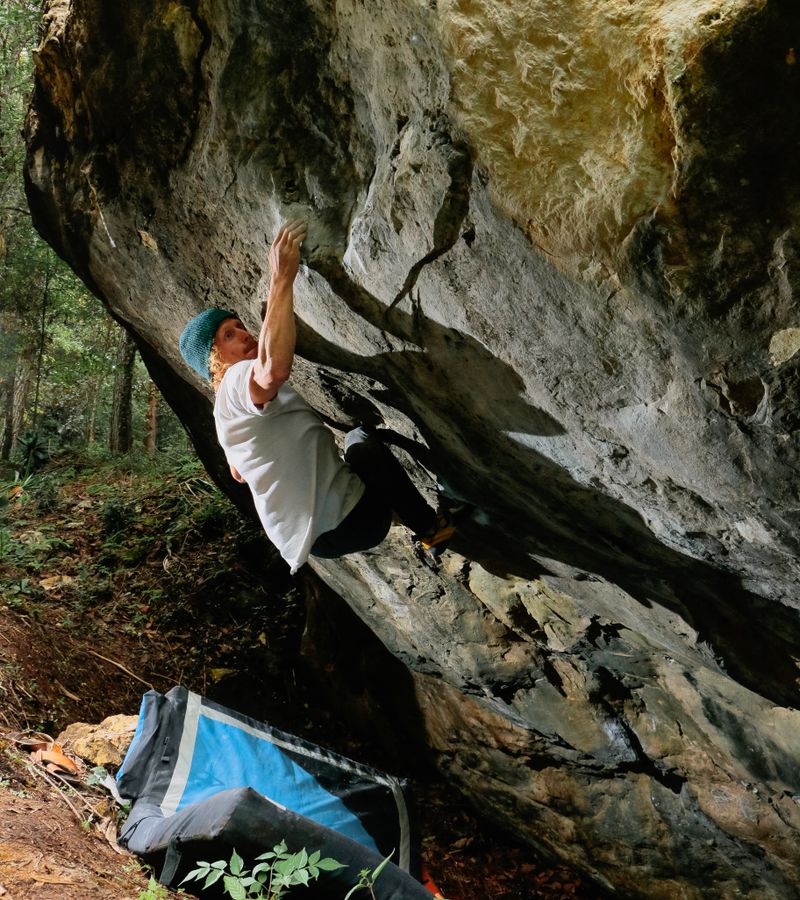
Header photo by Katya Wolf
More from the blog
 Mindset & community
Breaking through a climbing plateau
Why progress stalls, and the changes — volume, technique, rest — that get it moving again.
 Mindset & community
Learning from climbing on YouTube
How to use climbing films and channels to learn movement — and watch with a critical eye.
 Mindset & community
What we can learn from how the pros train
The habits elite climbers share — rest, reading, deliberate practice — that any climber can borrow.