Climbing and mental health
Focus, community and small wins — how time on the wall can be good for the head as well as the body.

Ask climbers why they keep coming back and the answers rarely start with biceps. They talk about the way a hard week dissolves the moment they tie in, or how a session with friends leaves them lighter than when they arrived. Climbing is physical, obviously, but a lot of what keeps people hooked happens above the neck.
The wall asks for your full attention
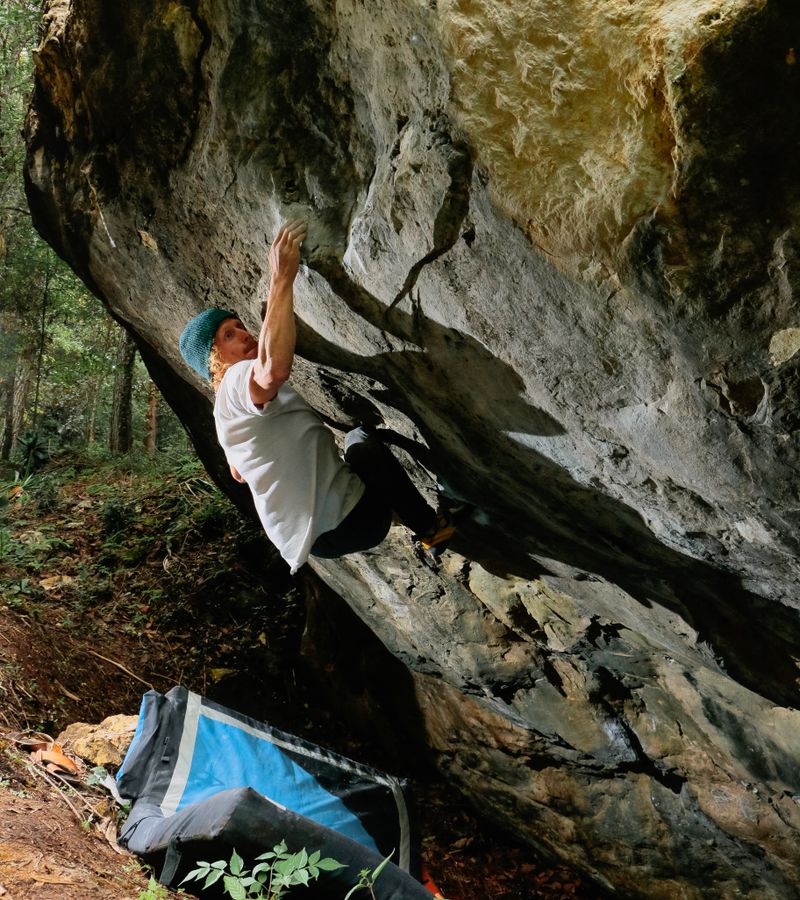
There is a reason it is hard to brood on a tricky email while you are committed to a heel hook above your last bolt. Climbing demands that you be where your hands are. The problem in front of you is concrete and immediate: which hold, which foot, how much weight to trust. That kind of narrow focus is closely related to what people call flow, the state where the noise quietens and time stops mattering.
You do not need to chase a peak experience to feel it. Even a steady evening on easy problems pulls your attention out of your head and into your body. For anyone whose mind tends to run laps after dark, that hour of enforced presence can be worth more than the climbing itself.
Small, honest wins
Climbing is generous with feedback. A move you could not do last week suddenly works. A grade that felt impossible becomes a warm-up. These are not vague affirmations, they are things that either happen or do not, and when they happen you earned them.
Mental health is often eroded by a sense that effort goes nowhere. Climbing offers a tidy antidote: visible, repeatable evidence that practice changes what you are capable of. The progress is rarely linear, and plateaus test everyone, but over months the trend is hard to argue with.
A few habits help keep that feedback healthy:
- Measure yourself against your own past sessions, not the strongest person in the gym.
- Treat a failed attempt as information, not a verdict. Most beta is discovered by falling off.
- Notice the non-grade wins too: better footwork, calmer breathing, a movement that finally clicked.
Community without the pressure
Few sports throw strangers together quite like climbing does. You spotting someone you have never met, swapping beta on a problem, sharing the small triumph when they finally stick it. That low-stakes contact, repeated over time, is how a lot of people build the loose web of acquaintances that real friendships grow from.
It matters because loneliness is one of the quieter threats to wellbeing, and gyms are unusually good at chipping away at it. There is no clock to beat, no opposing team, no real reason to be anything other than encouraging. People cheer for sends that are nowhere near their own grade because the effort is the point.
If you are climbing through a rough patch mentally, the social side can be a gentle on-ramp. You do not have to talk about how you are doing. You just have to show up, pull on, and be among people for a while.
Keeping it honest
None of this is a substitute for proper support when you need it. Climbing can lift a low mood, settle anxious thoughts and give shape to a week, but it is not therapy and it cannot fix everything. If things feel heavy in a way that does not lift, talk to your GP or a professional. The wall will still be there.
It is also worth watching that the sport stays a release rather than another stick to beat yourself with. The same drive that fuels progress can curdle into a grim obligation to send, to train, to be better. When you notice that creeping in, it is usually a sign to climb for fun for a while, with no projects and no expectations.
For most of us, most of the time, the maths is simple. You arrive carrying the day. You leave a bit clearer, a bit tireder, having spent an hour fully absorbed in something hard and human. That is a good deal, and it is available again tomorrow. Logging how you actually felt after a session, not just the grades, can quietly remind you why you keep going back.
Header photo by Rahadiansyah
More from the blog
 Mindset & community
Breaking through a climbing plateau
Why progress stalls, and the changes — volume, technique, rest — that get it moving again.
 Mindset & community
Learning from climbing on YouTube
How to use climbing films and channels to learn movement — and watch with a critical eye.
 Mindset & community
What we can learn from how the pros train
The habits elite climbers share — rest, reading, deliberate practice — that any climber can borrow.