Choosing a crash pad for bouldering
Single or double fold, big or small — how to pick a pad and how to place it well.

What a pad is actually for
A crash pad does not make a landing safe. It turns a hard, uneven, ankle-snapping landing into a softer, flatter one, and it gives you and your spotter something to aim a falling body towards. That mental shift matters when you are choosing. You are not buying a trampoline, you are buying a margin.
Most pads use a two-layer foam build: a thin, firm layer on top that spreads the impact, and a thicker, softer layer underneath that absorbs it. The firm layer is the bit that stops you punching straight through to the rock on a heavy fall. A pad that is all soft foam feels lovely to stand on and does very little when you land flat from three metres.
Fold, size and weight
The first decision is how it folds.
- Taco pads fold without a hinge, in one continuous bend. No gap to land in, but they are bulkier to carry and slowly take a set in the fold.
- Hinged (book) pads fold flat along a seam. They pack neatly and lie dead flat, but the hinge is a weak line. Never land on the seam, and overlap two pads so one covers the other's hinge.
- Hybrid or angled-hinge pads try to close that gap with an offset cut, and most modern pads land somewhere here.
Then size. A bigger pad covers more bad ground and absorbs more, but it is heavier on the walk in and harder to wrangle alone. For most people one medium pad plus a second smaller pad covers far more useful ground than a single huge one, because you can split them across two landings or stack them under the crux. If you mostly climb at a gym-style indoor wall you may not need one at all.
Weight and carry comfort decide whether the pad actually comes with you. A pad with a proper hip belt, padded straps and a flap to stash your shoes and chalk is worth the extra money if your walk-ins are long. The best pad is the one you do not resent carrying.
Placing it well
A good pad placed badly is not much use, so learn to read a landing.
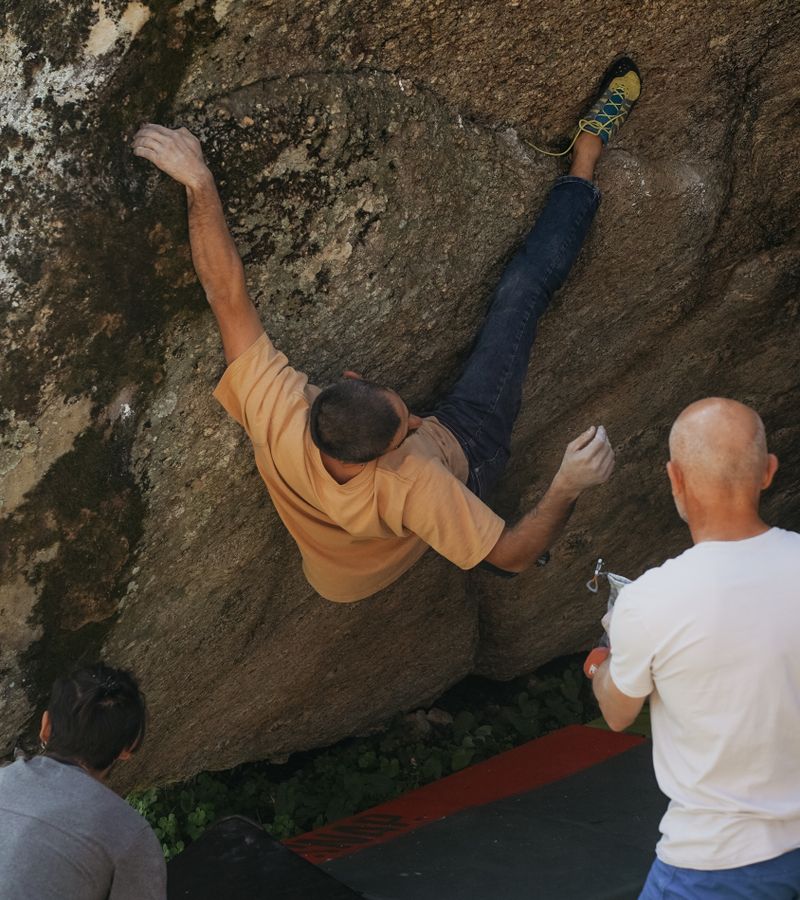
Clear the ground first. Pull out the obvious rocks and branches that sit under where you will fall, because a pad does not flatten a sharp edge, it drapes over it. Put the pad where your hips and back will land, not where your feet leave the ground, since on most problems you swing out and back as you come off.
Mind the gaps. If you are stacking two pads, overlap the edges and keep the seams away from the likely landing zone. A foot that finds a gap between two pads, or drops into a hinge, is how a lot of bouldering ankle injuries happen. A spotter's job is to steer your upper body and shift the pad under you as you move across, not to catch you.
Buy firm enough foam for the height you fall from, fold to suit your walk-ins, and place it like it matters every time. Keeping a quick note of which problems near you have nasty landings is a small habit that saves a lot of guesswork when you turn up with a finite stack of foam.
Header photo by gokiberk
More from the blog
 Gear
GearBelay devices explained
Tubes, assisted-braking and the differences that matter when you are holding a fall.
 Gear
GearWhat goes in a trad rack
A gentle introduction to the protection trad climbers carry, without the jargon overload.
 Gear
GearLooking after your climbing gear
Washing ropes, storing slings, checking for wear — simple care that keeps kit safe for longer.