How to climb slopers: how to hold what has no edge
Slopers feel hopeless until you stop trying to grip them. How friction, a low body position and staying still turn rounded holds into holds you can actually trust.
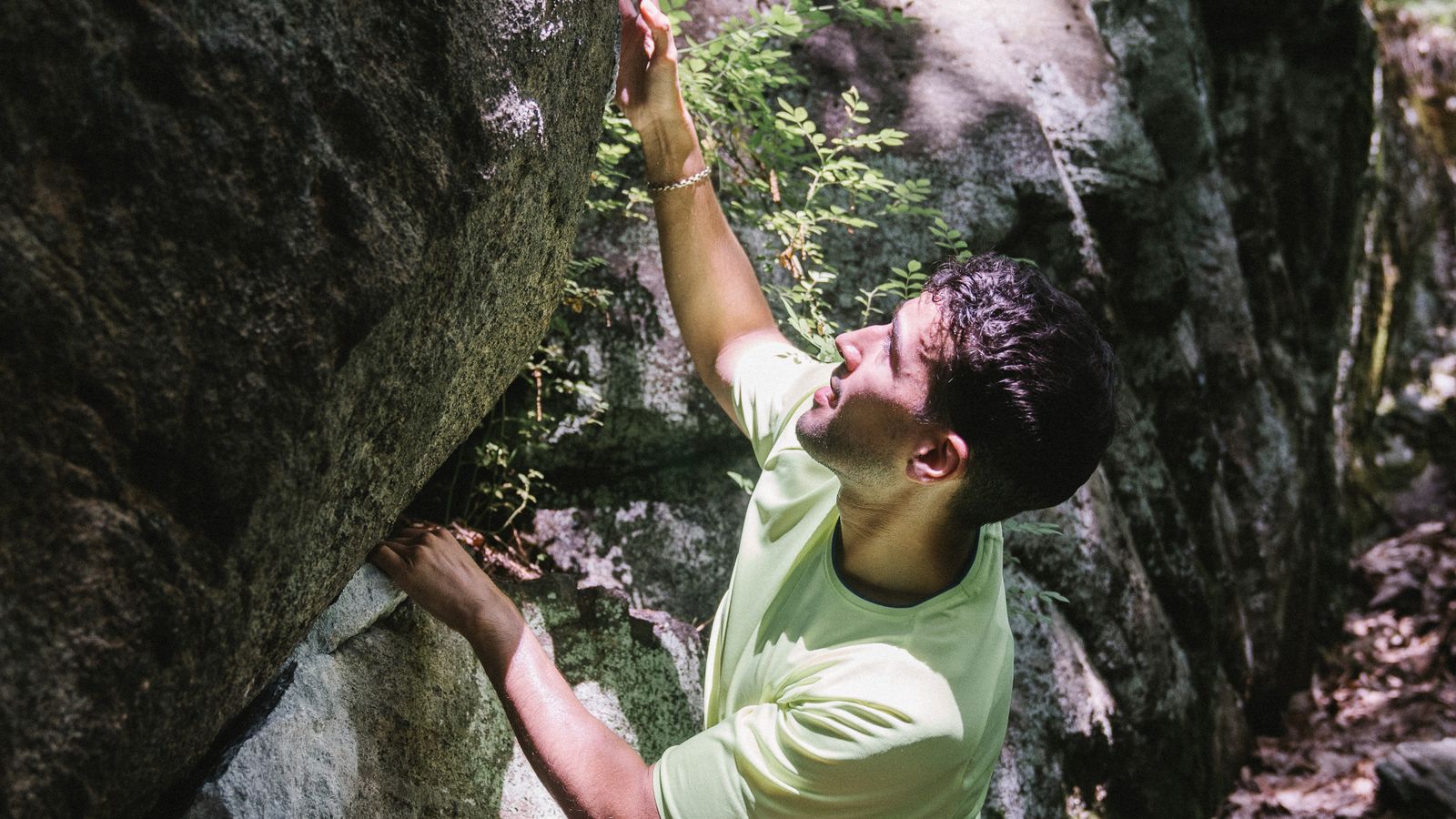
The hold you cannot grab
Most holds give you something to pull on. An edge, a pocket, a lip for your fingers to curl over. A sloper gives you none of that. It is a rounded, featureless bulge, and the first time you meet one it feels like trying to hold onto a bowling ball. Your hand slides, your feet cut, and you come off wondering what you were meant to do with it.
The answer is that you were never meant to grab it. You press on it. Once that clicks, slopers stop being the holds you dread and start being the holds you quietly enjoy, because they reward good climbing over raw finger strength.
It is friction, not grip strength
A sloper holds you on by friction alone. There is no positive edge doing any of the work, so the only thing keeping your hand there is how much skin you get on the rock and how cleanly you load it.
That gives you two things to control. The first is surface contact. Get as much of your hand on the hold as you can: full palm, finger pads spread wide, thumb down and pressing. A wide, soft hand grips a sloper far better than tight, bunched fingers. The second is direction, which is the part most people miss.
Get your weight under the hold
A sloper only works when you pull straight down through it, in line with the surface. The moment you lean out or drag it sideways, the angle changes and your hand greases off.
So the biggest fix for slopers is not your hand at all, it is your body. Drop your hips, keep your arms straight, and get your centre of gravity directly below the hold. Straight arms hang your weight cleanly down the line the sloper wants. Bent arms pull you out and away, which is exactly the direction that makes it slip. Low, heavy and long is the shape you are after.
Stay still
Slopers punish movement. Every time you readjust your hand you break the friction for a moment, and on a bad sloper that moment is all it takes to come off. Set the hand once, weight it, and try not to fidget with it.
The same goes for the whole move. Climb through a sloper smoothly rather than in sharp, snatchy pulls. Slow and quiet keeps the skin planted. Fast and scrabbly rips it off. If you watch a strong climber on slopers, the striking thing is how calm their hands look while everything else does the work.
Feet win sloper moves
Because you cannot pull hard on the hold, your feet have to carry more than usual. High, precise feet let you press your weight up into the sloper instead of hanging off it, which keeps that downward line you need.
Think about pushing up rather than pulling down. Keep your feet on, keep them loaded, and use them to drive your body into a position where the sloper is underneath you. A good foot placement often does more for a sloper than any amount of squeezing with the hand.
Skin, chalk and the weather
Friction is physical, so conditions matter more on slopers than on any other hold. Warm, damp hands are the enemy, which is why a July heatwave makes every sloper feel a full grade worse. This is not in your head. The rock is genuinely more slippery when it is hot.
Chalk up properly, and brush the hold to clear grease and old chalk before you commit. If you can, save your sloper projects for early morning or the evening when it is cooler and the skin stays dry. Cool, dry skin on a clean hold can turn something you slid off all afternoon into something that suddenly sticks.
Drills that build sloper trust
The fastest way to get comfortable is to spend time on them on easy ground, where a slip costs nothing.
- Sloper laps. On a board or an easy overhang, pick a problem that uses rounded holds and climb it again and again until your hands stop panicking.
- The hover drill. Match both hands on a sloper, then lift one and hover it in the air for a few seconds. It teaches you how much a single well-set hand can actually hold.
- Slow motion. Climb an easy sloper problem as slowly as you can. Moving slowly forces good body position and stops you snatching.
- Log what worked. When a sloper finally sticks, note the body position that made it happen. Track your sessions and the patterns show up fast, so you start reading slopers from the ground instead of discovering them halfway up.
Press, do not grab
Slopers feel impossible right up until the day they do not. Nothing about them is about crushing the hold. Get your weight underneath it, keep your arm straight and your hand soft, drive through good feet, and hold everything still. Give them a season of honest practice and the holds you used to skip become the ones you trust. Chalk up, stay calm, and press.
Header photo by Katya Wolf
More from the blog
 Training & technique
Thumb catches: how your thumb turns a bad hold into a good one
Most climbers grip with four fingers and leave the thumb doing nothing. Where a thumb catch helps, the four ways to use it, how to set it without tweaking anything, and the drills that make it a habit.
 Training & technique
Palming: how to push when there is nothing to pull
Palming means pressing an open hand against a hold, a volume or the rock itself so it holds you in place. Where it turns up, how to set the hand, why the arm stays straight, and the drills that teach you to trust it.
 Training & technique
Deadpoints: how to catch a hold at the top of the move
A deadpoint is a quick, controlled reach where you catch the next hold at the moment you stop rising. What it is, how it differs from a dyno, how to time the catch, and the drills that make it quiet instead of desperate.